Reverse Hyper Program
The Reverse Hyper Program Get the Program →

For the people with a reverse hyper in the building — strength coaches, clinicians and serious lifters

Have you ever used the reverse hyper and felt like it injured more than it helped?

Most people startwhere Louie ended.Start where he began.

The reverse hyper sequence Louie Simmons never published. It's taught by John Quint, the neuromuscular therapist who spent ten years next to Louie at Westside Barbell, treated him directly, and authored a chapter with him in Special Strength Development for All Sports.

10 yrs
Next to Louie Simmons
Ex. 05
Where most people start
Pro staffs
NFL · MLB · NHL · NCAA
The Reverse Hyper Program · 6 exercises · mastery-gatedEarn each one in order
01
No pendulum. No load.
Louie started here
02
Hamstring → hip → spine
03
Speed enters
04
Catch & dampen
05
Loaded pendulum
Most people start here
06
Top of the sequence

Exercises 1 through 4 are the four that get skipped — the joint function and reactive strength work that makes Exercise 5 safe.

Get the Program →
Lifetime accessEverything unlocks immediately30-day Point B Guarantee

The problem

The machine isn't the problem. The starting point is.

At an event in Columbus, a lifter joined our conversation. He talked about Louie with real admiration. Then he leaned in: “Just so you know, that reverse hyper destroyed my back.”

Day one, for most people
Ex. 05

A loaded pendulum, swinging, because that's what they saw on Instagram. It's the second-to-last step in the sequence.

Skipped
4

Exercises that build the joint function and reactive strength that make a loaded swing safe and productive.

Load in exercise one
0 lb

No pendulum. No external load. Run it on a reverse hyper, a treatment table or a GHD. This is where Louie began.

Louie's back was “still fragile”
1975

Bodyweight reverse hypers only. Two years later he pulled 710 lb in the 198 class.

It's not flexibility. It's not mobility. It's a reactive strength deficit.

The reason a low back stays tight no matter how much you stretch it, and keeps seizing back up, isn't range of motion. It's reactive strength: the most undertrained quality in the human body, and almost nobody programs for it.

So the tissue never gets what it needs, and the guarding never lets go. Hang a loaded pendulum on top of that and you're asking a spine to catch force it was never prepared to catch. That's why the reverse hyper works for one athlete and hurts the next.

Why listen to us

Learn from the people who were actually there.

John Quint is a neuromuscular therapist, and he spent ten years treating Louie Simmons directly. They started on Louie's psoas, and Louie got fascinated with what the reverse hyper was doing to that tissue. That work became a chapter John authored with Louie in Special Strength Development for All Sports.

Along the way Louie, the man who invented and patented the machine, told John how it really started. Jim Seitzer, Louie's training partner from the '70s on, filled in the rest.

“In 1975, my back was still fragile.”

Louie Simmons · Powerlifting USA From Louie's own article. What he did next is Exercise 1 of this program.
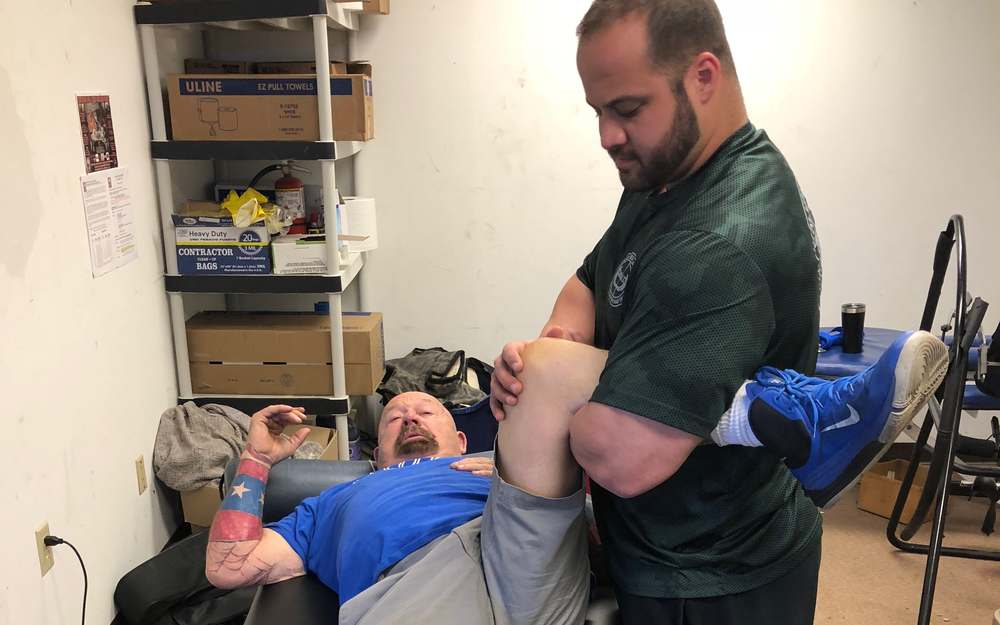
John Quint assessing Louie Simmons on a treatment table
John assessing Louie Simmons.
1975
Bodyweight only

Louie starts reverse hyperextensions with no pendulum. He rotates the sacrum and pumps blood into the tissue.

Louie's garage
A carpenter's belt

As he gets stronger he wraps a carpenter's belt around the roller and hangs plates from it. The pendulum is born, out of convenience.

1977
710 lb at 198

A spine that had been on crutches pulls 710. The progression came first. The pendulum came later.

Today
Exercise five, first

Anyone can buy the machine. Most people load the pendulum on day one and start exactly where Louie ended.

JQ
John Quint
Neuromuscular Therapist · Ten years treating Louie Simmons

Treated Louie Simmons directly and authored a chapter with him. Built the program's six-exercise sequence and teaches the full course.

Core program
MC
Dr. Michael Chivers
Sports Specialist Chiropractor

Ran the cadaver lab at the Canadian Memorial Chiropractic College. Knows the tissue each exercise trains because he's actually dissected it.

Absolute co-founder
PL
Paul Leduc
Manual Therapist & Strength Coach

Runs this program on athletes every week, and uses the reverse hyper to find out where an athlete actually is before programming a single rep.

Absolute co-owner

The sequence

A Point B spine is earned, one exercise at a time.

Louie programmed the reverse hyper for powerlifting, tied to the box squat and the deadlift. We don't train the spine as a rigid anti-movement pillar, and we don't train it for a total. We train it toward a Point B spine: movable, segmental and reactive, built on three capacities.

Joint Function

The spine flexes and extends segment by segment, under control. Sacrum, L5, L4, one at a time.

Strength Endurance

Holding terminal positions, like the four-second multifidus hold at the top of Exercise 1.

Reactive Strength

The connective tissue's ability to catch and dampen force. The pendulum only builds it once the spine has earned the swing.

Six exercises, in order, gated by mastery standards. It's the same logic the Soviets used: you earn the next exercise. You don't move on because the calendar says so. By the time your athlete reaches the loaded pendulum, the thing everyone starts with, they're finally ready for it.

The LadderEarn each one in order
01
Sacral drive
No pendulum · no load · pulling isometric
Louie started here
Mastery gate
02
Hamstring → hip → spine
Linking the chain
Mastery gate
03
Speed enters
Speed strength gets the pendulum moving
Mastery gate
04
The catch-and-dampen
Where reactive strength is built
Mastery gate
05
Loaded pendulum
What you see on Instagram
Most start here
Mastery gate
06
Top of the sequence
Only after 01–05 are mastered

Exercise 1 runs on any reverse hyper, a treatment table or a GHD. It rebuilds the connection between the nervous system and the spine before anything swings.

Free training · recorded · 39 min

Not ready yet? Watch the free training first.

39 minutes with John Quint, Paul Leduc and Dr. Michael Chivers: where the loaded pendulum really belongs, the three capacities of a Point B spine, and Exercise One coached on the machine so you can check your set-up against ours.

Recorded, so you can watch it now. Free.

01The full sequence, explained. Why the machine is usually used for its last step first, and what comes before it.
02Exercise One, coached. The set-up, the pulling isometric, sacral drive and the four-second hold, rep by rep.
03The mastery standard card. One page every attendee gets: the reps, the hold, and the marker that says move up or stay.

Watch the free training

Name and email, then it plays. Free.

Name and email on the next page. No spam, unsubscribe any time.

Inside the program

What you'll finally understand

The reverse hyper doesn't stop working because it's a bad machine. It stops working because nobody taught the onboarding. Here's what changes when you have it.

  • Why the exercise almost everyone does first is actually step five, and what the four exercises before it build.
  • The pendulum was an accident. How a carpenter's belt in Louie's garage became the way everyone uses the machine, and why that's backwards for a spine that isn't ready.
  • Low back still tight no matter how much you stretch it? Why it was never a flexibility or mobility problem.
  • What you should never do on day one with a new athlete on the reverse hyper, even a strong one.
  • The catch-and-dampen: how to use the pendulum to build reactive strength instead of just swinging weight.
  • How to know, objectively, when an athlete has earned the next exercise, and when they stay where they are.
  • No reverse hyper? How to run the full sequence on a treatment table or a GHD.
  • The pulling isometric Louie didn't use, and why adding it teaches the nervous system to catch the pendulum.
Get the Program → One-time payment · lifetime access · 30-day guarantee

Proof

Not theory. Running right now in pro and college weight rooms.

This program runs inside NFL, MLB, NHL and NCAA programs. It isn't built for one sport or one athlete. It's a sequence anyone can run, on any roster.

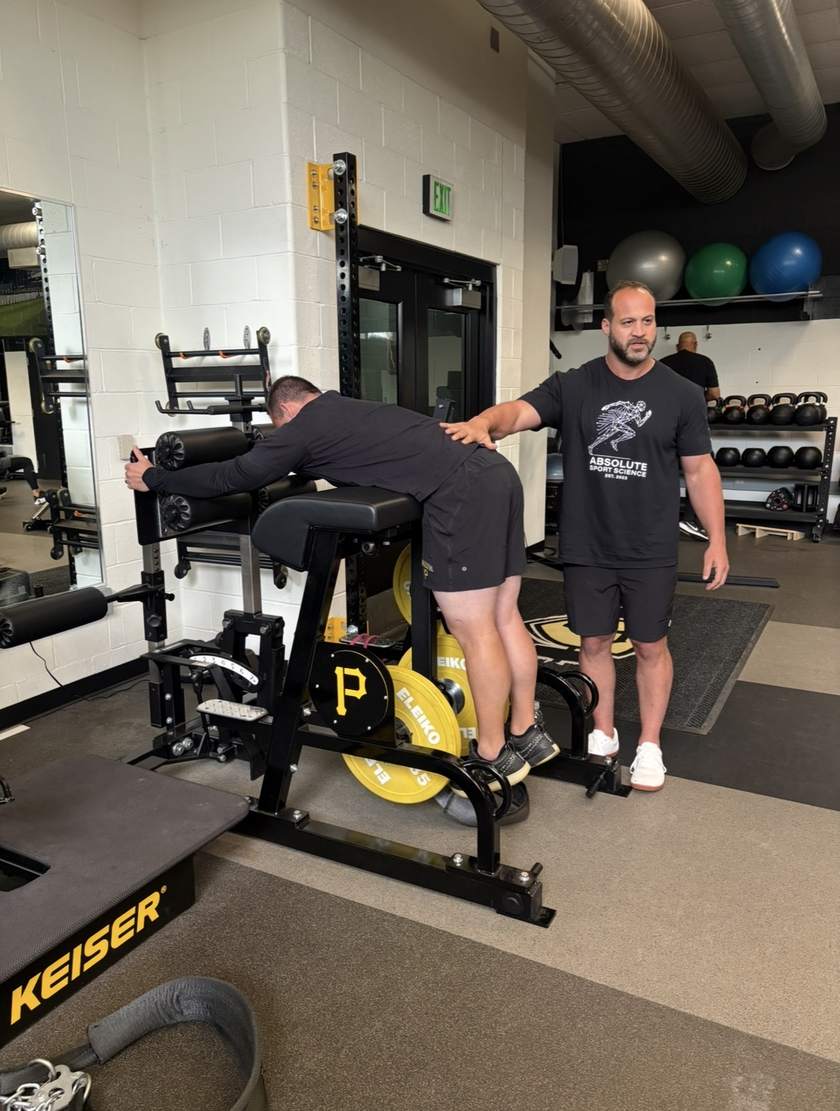
John Quint coaching an athlete on a reverse hyper in the Pittsburgh Pirates weight room
John coaching the sequence in the Pittsburgh Pirates’ weight room.
“I always knew the worth of the reverse hyper and how valuable it could be for my athletes, but struggled with how to gain traction with it from the players. With this program and how it is structured, I feel confident I can implement these exercises with ease to accomplish numerous capabilities that my athletes are missing. As a rotational sport, with a lot of potential low back reactive strength injuries, I can use this program to build the low back from the bottom up.”
AB
Alan Burr
Strength & Conditioning, Pittsburgh Pirates
“The reverse hyper program has been a game changer for me! The best aspect of the reverse hyper program is the specificity when it comes to “mastery” of an exercise and knowing when it is time to progress. There is a great natural progression to the program that forces athletes to focus on not just doing the exercises, but doing them correctly so that the desired adaptation is met. Athletes enjoy the program because it is new, simple, efficient, and solves problems they’re facing. This program has become a go to for dealing with certain issues that many athletes face day-to-day.”
AG
Adrian Guardado
Director of Return to Play, UCLA Football
“Absolute is a valuable resource for any strength practitioner looking to improve human performance. It provides a different lens through which I approach treatment and training. The “Reverse Hyper Program”, specifically, has deepened my understanding of how the spine responds and adapts to load and has reframed the way I approach spinal loading in both rehabilitation and performance.”
RM
Ryan Maedel
Rehab Strength & Conditioning, Philadelphia Phillies
“Paul together with his team at Absolute Sport Science have found a massive gap in low back health care. I had used the RH in the past but never knew how to start with the basics. From neurological connection to strength and stability the months I have spent progressing through the RH program have helped me in my job as a Fire Fighter as well as in my day to day life.”
NM
Nick M.
Firefighter
“The Reverse Hyper Program is a great reset to the ideology of how to build a resilient spine. It is a logically sequenced and programmable strategy that step by step can be regressed and progressed based on the spine brought to the reverse hyper. The pendulum provides a stimulus that cannot be otherwise created but the logic and thought put into it make sure you arrive ready to use the pendulum when it is time. This is a must for anyone looking to rehabilitate a spine or build a stronger, more prepared spine for whatever sport or life throw at it. Thanks Absolute!”
MP
Matt Peragine
Head Athletic Trainer, Miami Hurricanes Football

His dad raised him on reverse hypers. He still had the back pain.

Jonathan Davis  ·  Strength & Conditioning, Return to Play · University of Florida Football On regressing athletes to Exercise One
NFLMLBNHLNCAA

Case study · University of Florida Football

“We had a [player] who had a history of low back stuff going back for years now. And the funny thing is, his dad — huge Westside guy. So he had been doing reverse hypers his whole life, but he still was having issues with low back pain. It would always flare up on a heavy squat day, a heavy deadlift, or from a high-volume run day.

I got with him as soon as I got the reverse hyper program and we got right to work, and we really had some great results. About every three weeks we were able to move through one of the progressions, where we didn't really have any setbacks. I think that's really to the credit of the progressions that the program took the reverse hyper through.

To the point where now he's doing full reverse hypers and he hasn't had anything wrong with his back. Knock on wood — but he hasn't had anything going on for months now. And he uses a lot of those progressions — like I told him, he is forever doing Exercise One.”

JD
Jonathan Davis
Strength & Conditioning, Return to Play · University of Florida Football

And it didn't stay with one athlete. “I implemented Exercise One with almost the whole team. Our guys love it — that's almost where all our guys go to start their low back work now.”

Quoted from our Founders Meeting with Jonathan Davis — watch the full conversation.

What you get

Everything inside the Reverse Hyper Program

One program, built to take you from “I own a reverse hyper” to “I know exactly where every athlete starts and when they move up.” Plus one optional add-on at checkout.

The core program
Conjugating a Point B Spine

The full sequence Louie never published, built by John Quint, Dr. Michael Chivers and Paul Leduc, with every exercise on video and every mastery standard spelled out.

$497one payment
The full course on conjugating a Point B spine

Program joint function, strength endurance and reactive strength together, not one after another.

All six exercises on video, with coaching cues

Watch it, cue it, and run it with the athlete right in front of you.

The adaptation series

No reverse hyper? Run the sequence on a treatment table or a GHD.

The full program PDF

Louie's history of the machine, the Point B framework, the three phases and every mastery standard.

Optional add-on+$97at checkout

Advanced Programming Tactics

What it isA set of advanced programming tactics for once your athlete masters the sequence, including a new exercise and spine biases on the ones they have already mastered, so they keep progressing.
Who it's forCoaches whose athletes have already cleared the mastery standard on Exercise 5, or will soon.
How to get itTick the box at checkout. Skip it and the program is complete on its own.

The offer

Five figures in person. $497 self-paced.

One payment, lifetime access, and everything unlocks the second you're in. Start Exercise 1 today.

01 Five figures What an organization pays to have us in the building to install this program in person.
You $497 The same program, self-paced, which is why it doesn't cost five figures. One payment, lifetime access, everything unlocked immediately.
Reverse Hyper ProgramWhat's in the box
ProgramThe full course on conjugating a Point B spine✓
ProgramAll six exercises on video, with coaching cues✓
ProgramThe adaptation series (treatment table and GHD)✓
ProgramThe full program PDF, with every mastery standard✓
OptionalAdvanced Programming Tactics, added at checkout+$97
The program
$497

One payment. No subscription, no instalments.

Across an 85-man roster that's about $6 an athlete, once, not per season. Buying it for yourself, it's one payment for the sequence you'll use on that machine for the rest of your training life.

Get the Program →
Secure checkoutLifetime access30-day Point B Guarantee
THE POINT B GUARANTEE · RISK IS ON US · 30 DAYS

The Point B Guarantee

Run Exercise One for 30 days.
On one athlete, or on yourself.

If you don't see the segmental control and joint function change, or you just don't think this is the most complete reverse hyper program you've ever been handed, email us and we'll refund every dollar.

The risk is entirely on us.

Is it for you?

Built for the people responsible for the spine.

Professional-grade education — for the coaches and clinicians responsible for other people's spines, and for the lifters responsible for their own. It isn't a stretch routine and it isn't a powerlifting accessory.

This is for you if…
  • You're a strength coach with a reverse hyper in the facility, or you're thinking about getting one.
  • You're a physical therapist or manual therapist whose athletes' low backs stay tight no matter what you do on the table.
  • You're an athletic trainer responsible for keeping a roster's spines healthy across a full season.
  • You train yourself, or the crew you work with — there's a reverse hyper in the gym, the garage or the hall, and your low back is the thing that keeps flaring up.
  • You've watched the pendulum help one athlete and hurt the next, and you want to know why.
This isn't for you if…
  • You want a total-boosting accessory for powerlifting. Louie already wrote that program, for that sport.
  • You'd rather keep loading the pendulum and hoping than earn each exercise in order.
  • You're looking for a quick stretch routine. This is a mastery-gated training sequence.

Why this and not something else?

There is no shortage of spine content. What there is a shortage of is the onboarding, and there's a reason for that: Louie never published it. He lived it, in his own garage, in 1975.

The only people who can teach it are the people who were in the room — the therapist who treated him for ten years and co-authored with him, and the training partner who was there when the pendulum was a carpenter's belt. Everything else you can buy about the reverse hyper starts at Exercise 5, because that's the only part that ever got written down.

Questions

Before you click.

Every question a coach or clinician has actually asked us about this program. If yours isn't here, email us and we'll answer it straight.

Fit and difference

I already use the reverse hyper. Why do I need this?

If you load the pendulum and swing, you're running our Exercise 5. This program gives you Exercises 1 through 4 — the joint function and reactive strength work that make Exercise 5 safe and productive — plus the mastery standards that tell you when an athlete has earned it. Most coaches find the machine starts producing something different within a few weeks, using the same equipment they already own.

I don't own a reverse hyper. Can I still run it?

Yes. The adaptation series shows you how to run the sequence on a treatment table (for clinicians) or a GHD (for strength coaches). Exercise 1 needs no pendulum and no external load at all. A number of people buy this before they buy the machine, specifically so they know what they're buying it for.

How is this different from Louie's reverse hyper programming?

Louie programmed the reverse hyper for powerlifting, tied to the box squat and the deadlift. He was training for a total. This program is built for a Point B spine: joint function, strength endurance and reactive strength. It starts where Louie himself started in 1975, then adds a pulling isometric so the nervous system learns to catch and dampen the pendulum — which is the piece that turns the machine into reactive strength work instead of a blood-flow exercise.

How is this different from the free content you post?

What we post is demonstration. This is the sequence, the order, and the standard. The free content shows you what an exercise looks like; the program tells you which one this athlete should be doing, how you'll know they've earned the next one, and what to do when they stall. That's the part that can't be taught in a reel.

I train myself, not a team. Can I run this?

Yes. Louie ran it on himself, alone, in a garage, in 1975 — that is the origin of Exercise 1. Nothing in the sequence needs a second person.

The language throughout is coaching language — "your athlete" — because most people running it are coaching somebody else. Read it as being written to you. The mastery standards are things you can feel: whether the control holds from the first rep to near failure, whether the four-second hold stays precise, whether one side moves differently to the other. Film a set on your phone if you want to check the last one. And if a standard is ever ambiguous, stay where you are — the gate exists to protect you, not to slow you down.

Will it transfer to my sport?

The program trains three capacities of the spine, not a sport skill, so it transfers the way any quality does. It's currently running in rotational sport, collision sport and on the ice — NFL, MLB, NHL and NCAA programs. Nothing in the sequence is sport-specific; what changes by sport is where it sits in your week.

Running it

How long does it take to get through, and how long is a session?

The course itself is a few hours and you can watch it in a weekend. The sequence is not a timeline — it's mastery-gated, so an athlete moves when they meet the standard, not when a calendar says so. In practice the exercises themselves take minutes, not a block of your session. Exercise 1 is short enough to run inside a warm-up or on the table.

Can I run this across a full roster, or is it one athlete at a time?

A full roster — an SEC football program is currently running it across their entire team, and their return-to-play director says so on camera above.

That's what the mastery standards are for: different athletes sit on different rungs of the same ladder at the same time, and each one moves when they've earned it. The mastery standards are what make that manageable: you check the standard with the athlete in front of you, and it tells you move up or stay.

My staff will be delivering this. Can they learn it without me?

Yes, and that's the intent. Every exercise is on video with John's coaching cues, and the mastery standards are objective rather than a matter of judgment. You get lifetime access, so an intern who arrives next season learns it from the same source you did.

Do I need an anatomy background?

No. John explains what each exercise is doing to the tissue in plain language, as he coaches it. You need to know what to look for, not pass an anatomy exam.

How do I know when an athlete is ready for the next exercise?

Every exercise has a mastery standard, spelled out on video and in the program PDF. Check it with the athlete in front of you. If they meet it, they move up. If they don't, they stay where they are.

What about an athlete who's currently in pain, or post-op?

This is professional education, not a treatment protocol, and it doesn't replace your own assessment. Run it inside your scope of practice and your return-to-play criteria, the same as anything else you'd program. What the program gives you in that situation is an entry point that carries no external load at all, and an objective standard for when to progress — which is usually the harder decision.

Price, access and payment

Honestly, is it worth $497?

Two ways to look at it. First, we charge organizations five figures to install this program in their building; this is the same program, self-paced. Second, the per-athlete math: across an 85-man roster it's about $6 an athlete, once. Not per season, and not per athlete after that. You keep it for every athlete who comes through your program from here on.

If you're buying it for yourself, the per-athlete math doesn't apply — the comparison is one payment, once, against however many more years you'd spend guessing on a machine you already own.

And if neither of those convinces you, the guarantee should: run Exercise 1 for 30 days, on one athlete or on yourself, and if it doesn't do what we say, you pay nothing.

Is this a subscription? How long do I have access?

Not a subscription. One payment of $497, and access is for life, including any updates we make to the program. Nothing recurs and there's nothing to cancel.

Can I expense this through my program?

Yes — you'll get an itemised receipt at checkout that you can submit for reimbursement or against a professional development budget. If your organisation needs an invoice made out to them instead, or a W-9 on file before they'll pay, email us before you buy and we'll send it over.

What happens right after I pay?

Everything unlocks immediately: the course, all six exercise videos, the adaptation series and the program PDF. If you added Advanced Programming Tactics at checkout, that unlocks too. You'll get login details by email. Most people watch the course first and start Exercise 1 with an athlete the same week.

Risk

What if it isn't for me?

Run Exercise One for 30 days — on one athlete, or on yourself. If you don't see the segmental control and joint function change, or you simply don't think this is the most complete reverse hyper program you've ever been handed, email us for a full refund. No form, no hoops.

Who's actually behind this?

John Quint, a neuromuscular therapist who treated Louie Simmons directly for over ten years and authored a chapter with him in Special Strength Development for All Sports. Dr. Michael Chivers, who ran the cadaver lab at the Canadian Memorial Chiropractic College. And Paul Leduc, a manual therapist and strength coach who runs this program on athletes every week. This isn't a reading of Louie's articles. It's the onboarding he described to the man treating him.

Get the Program → $497 one time · lifetime access · 30-day guarantee

Start today

Start where Louie started.

The only thing standing between your athletes and a spine that holds up is the sequence. Now you can have it.

Get the Program →

$497 one time · lifetime access · 30-day Point B Guarantee

P.S.

This was built with the therapist who treated the man who invented the machine, built with the anatomist who ran the cadaver lab, and an SEC football program is running it across their entire roster right now. That combination doesn't exist anywhere else, because Louie never wrote the onboarding down.

Every session an athlete spends swinging a loaded pendulum without Exercises 1 through 4 asks their spine to catch force it hasn't earned. The full program is $497, and you have 30 days to prove it, on one athlete or on yourself, or you pay nothing. Get the program now →

Not ready to buy? Watch the free training first.